


Two nations, one island, and two fundamentally different answers to the same question: what’s the best way to get workplaces recycling properly?
Since April 2024, every workplace in Wales — regardless of size — has been legally required to separate its recycling into distinct streams. Since March 2025, workplaces in England with ten or more employees have been required to arrange recycling collections under Simpler Recycling — but with one crucial difference: England allows most dry recyclables to be collected together in a single container.
That difference sounds technical. It isn’t. It’s a bet on human behaviour, and the two governments have bet in opposite directions. Here’s our honest assessment of both — including where the English approach has genuine merit, and where we think it falls short.
What Wales Requires
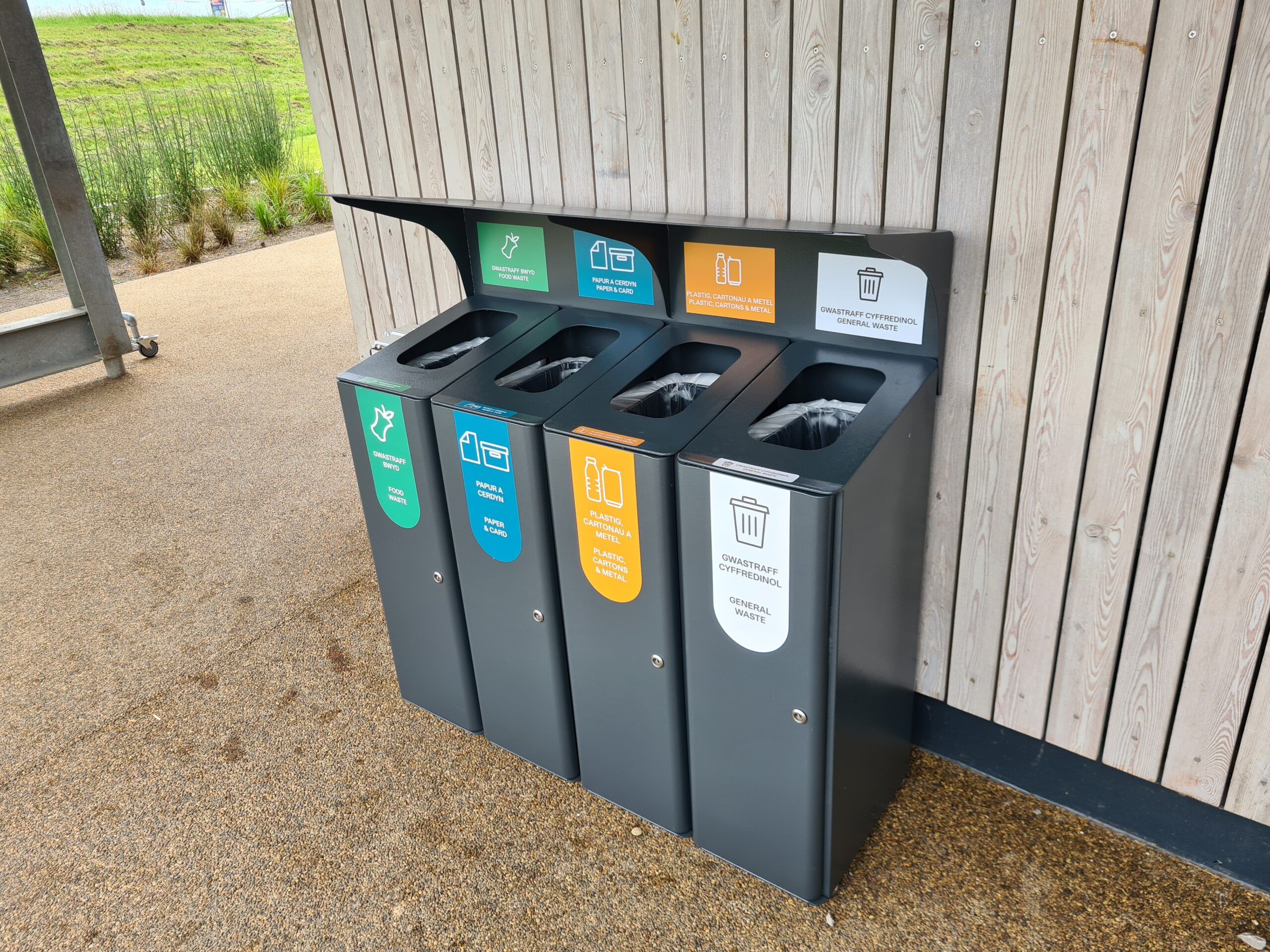
The Workplace Recycling Regulations, in force from 6 April 2024 under the Environment (Wales) Act 2016, require all workplaces — businesses, public sector and third sector alike — to present the following streams separately for collection:
- Paper and card
- Glass
- Metal, plastic and cartons
- Food waste (for premises producing more than 5kg per week)
- Unsold small electrical items
- Unsold textiles
The regulations also ban food waste from going to sewer, and prohibit separately collected recycling from being sent to incineration or landfill. There is no small-business exemption: a two-person office has the same core obligations as a national distribution centre.
What England Requires
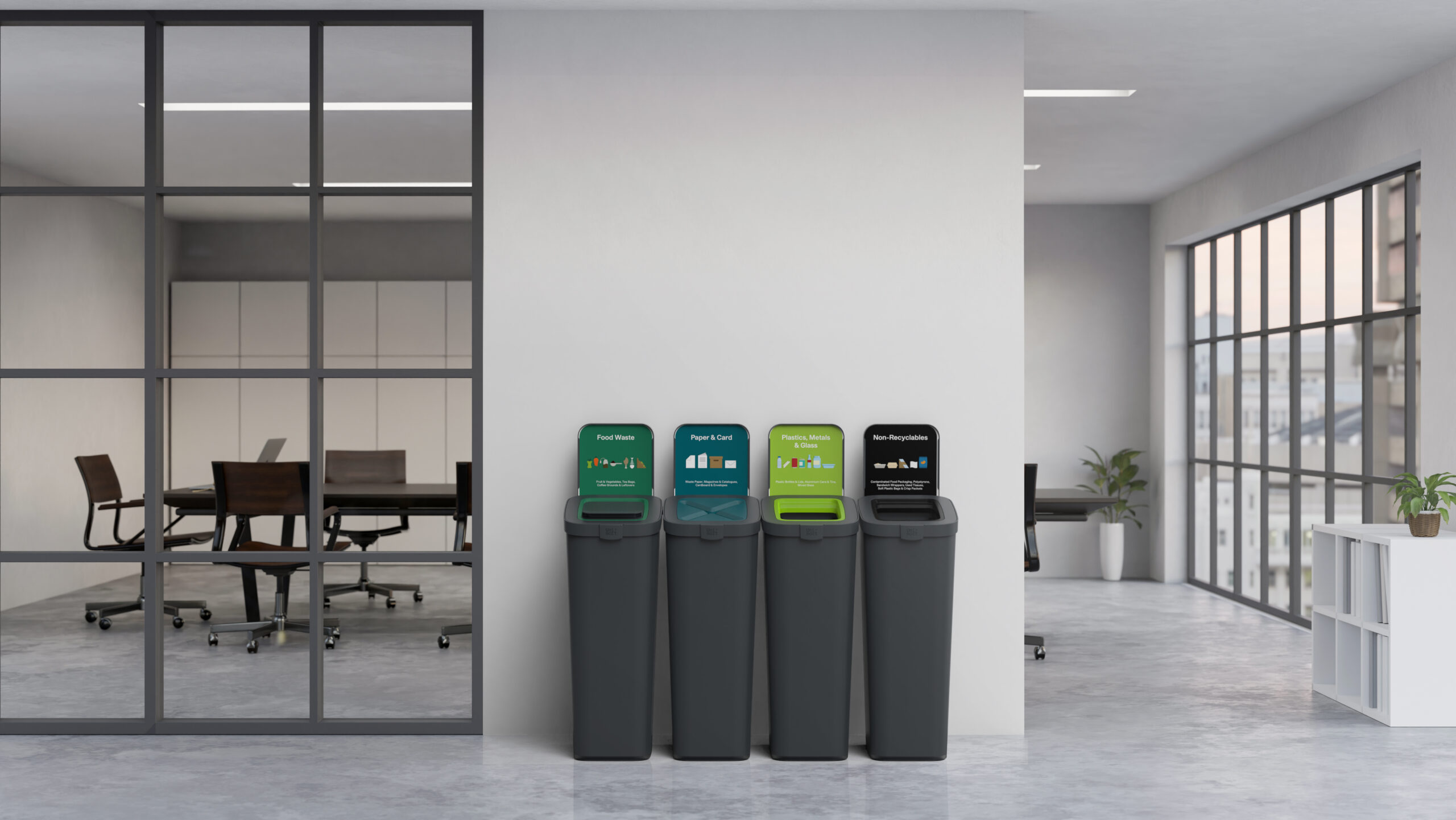
Simpler Recycling, introduced under the Environment Act 2021, took effect for workplaces with 10 or more full-time equivalent employees on 31 March 2025 (micro-businesses follow in March 2027). Workplaces must arrange collection of:
- Dry recyclables — glass, metal, plastic, and paper and card
- Food waste
- General waste (residual)
The key design choice: DEFRA’s default position allows glass, metal and plastic to be co-mingled in a single container, with paper and card typically kept separate — and even that can be relaxed by written assessment. In practice, many English workplaces can comply with as few as three containers: dry recycling, food waste, and general waste.
The name is the philosophy. Simpler Recycling was explicitly designed to reduce complexity and cost for businesses, standardise what’s collected across the country, and end the postcode lottery of local rules.
The Case For England’s Approach
Let’s be fair to it, because the arguments aren’t trivial.
Lower barriers drive participation. The strongest argument for co-mingling is that convenience gets more people recycling in the first place. A business that finds compliance easy is more likely to comply at all.
Lower cost and less space. Fewer containers means fewer collections, smaller footprints in back-of-house areas, and simpler contracts — a genuine consideration for small premises, hospitality sites and older buildings.
Modern sorting technology. Materials recovery facilities have improved dramatically, and proponents argue that mechanical sorting can do downstream what people are unreliable at doing upstream.
Consistency at last. Before Simpler Recycling, England’s business recycling landscape was fragmented and confusing. A single national standard — even a permissive one — is progress.
The Case For The Welsh Approach
Separation at source produces cleaner material. The Welsh Government’s Code of Practice highlights that co-mingled collections can lead to cross-contamination between materials, reducing the quality of recyclate. In some cases, contamination is so severe that entire loads are rejected and sent for energy recovery or landfill instead. This is one of the key reasons Wales requires recyclable materials to be separated at source.
Local authority experience supports this approach. For example, Vale of Glamorgan Council reported reducing contamination from around 15% to under 1% after introducing source-separated collections.
The behavioural argument. Co-mingling asks people to make almost no decision — and gets almost no engagement in return. A single “recycling” container becomes a slightly virtuous general waste container: if in doubt, it goes in. Separated streams ask each person to make one small, conscious choice, and that moment of engagement is where behaviour change actually happens. In our experience across hundreds of workplaces, the point of disposal is the only point where recycling behaviour can genuinely be influenced. Design the decision well — clear streams, clear signage, consistent placement — and people get it right. The problem was never your staff. It was the system.
Wales’s track record. Wales didn’t arrive at this policy by accident. It has led the UK’s recycling performance for years and now recycles 68.4% of its municipal waste — the highest rate in the UK and one of the best-performing recycling systems in the world. This success has been built on a long-term commitment to source separation, first in households and now in workplaces. The UK’s household recycling rate, by contrast, has remained between 44% and 46% for more than a decade. In its 2026 progress report to Parliament, the Climate Change Committee rated progress as “off track” and noted that the Government’s Carbon Budget and Growth Delivery Plan contains no target for improving the rate.
End-market quality. Cleaner streams command better prices and are more likely to be genuinely recycled in the UK rather than downgraded or exported. If the policy goal is a circular economy rather than a collection statistic, material quality matters as much as tonnage.
So Which Is Working Better?
Here’s where we’ll be more honest than most commentary on this subject: it is too early for a definitive, data-backed verdict. Wales’s workplace regulations have been in force for just over two years; England’s for barely one. Robust comparative data on workplace contamination and capture rates does not yet exist in the public domain.
What we can say is this: one of these regimes is aligned with everything the evidence tells us about contamination, material quality and behaviour change — and with the track record of the UK’s most successful recycling nation. The other is aligned with minimising short-term cost and friction.
Our view, stated plainly (and yes — as designers of multi-stream recycling stations, we have skin in this game): England has legislated for collection, while Wales has legislated for behaviour. Simpler Recycling gets containers into buildings. The Welsh regulations change what happens at the moment someone stands in front of them. Over time, we believe that difference will show up in the data — in contamination rates, in rejected loads, and ultimately in how much material is actually recycled rather than merely collected.
What This Means If You Operate In Both Nations
For multi-site organisations — retail and hospitality, facilities management, higher education — the pragmatic question isn’t which government is right. It’s whether to run two different systems either side of the border.
Our recommendation is almost always no. Standardise on the higher standard. Running Welsh-compliant separation across your whole estate gives you:
- One set of signage, training and internal comms instead of two
- Compliance headroom in England if (as many in the industry expect) requirements tighten toward separation over time
- Cleaner streams and better data everywhere, not just where the law demands it
- A sustainability story you can report with confidence
Meeting only the English minimum, meanwhile, means rebuilding your approach if the rules change — and living with the contamination problem in the meantime.
The Question We’d Put Back To England
Simpler Recycling was a genuine step forward from what came before. But “simpler” was optimised for the businesses buying collections, not the people using the containers — and it’s people, not contracts, who determine what ends up in each stream.
Wales asked more of its workplaces and, on every long-term measure we have, has been rewarded for it. The question isn’t really whether England should follow Wales. It’s how long England can afford not to.
Unisort designs recycling stations and behavioural change programmes for organisations with 500+ staff across the UK — on both sides of the border. If you’re working out what compliance should look like across your estate, talk to us.