Unisort iQ Workplace Waste Intelligence
The challenges with workplace recycling
Contamination
Recyclable material regularly ends up in general waste.
Compliance
Inconsistent systems create legislative and reputational risk.
Consistency
Different rules across floors and sites confuse staff and drive contamination.
Multi-tenant buildings
You can’t see who produces what
Waste from every tenant ends up in the same place, so there’s no way to tell who produces the most waste or contamination.
Costs are split unfairly
Charges are divided by floor area or a flat fee, so tenants who recycle well pay for those who don’t.
Contamination has no source
Contaminated bags turn up at collection with no way of tracing them back to the tenant who filled them.
Contractor charges you can’t check
Invoices are based on estimates or collection counts, not weighed data.
Tenants want data you can’t give them
Tenants need accurate waste figures for their own sustainability reporting.
One site, multiple departments
You can’t see which areas are the problem
Waste from every department and area of the building is collected together, so the hotspots stay hidden.
Contamination you can’t trace
Is it the kitchen, the office floors or the warehouse? Without data, finding the source is guesswork.
No proof your efforts are working
You’ve invested in training and signage, but can’t measure whether behaviour has changed.
Reporting based on estimates
Sustainability figures rely on averages rather than real, weighed data.
One company, multiple locations
No like-for-like view across sites
Each site reports differently, so you can’t compare performance or see which locations are struggling.
Costs split without real data
Waste costs are allocated by headcount or floor space, not by what each site actually produces.
Contamination at some sites, not others
Some locations get it right and others don’t – but you can’t see why, or share what works.
Different contractors, different data
Every contractor reports in its own way, and weights are rarely verified.
Group reporting relies on spreadsheets
Pulling ESG figures together means chasing every site for estimates.
The problem was never your staff. It was the system.
Unisort iQ falls under the fifth stage of the Unisort System – Optimise
It measures what happens at every recycling station, so you can keep improving performance over time.

Diagnose
Understand the problem.

Design
Create the right solution.

Deploy
Roll out the system.

Engage
Get your team on-board.

Optimise
Measure and improve.
Our solution
Four parts, one connected system
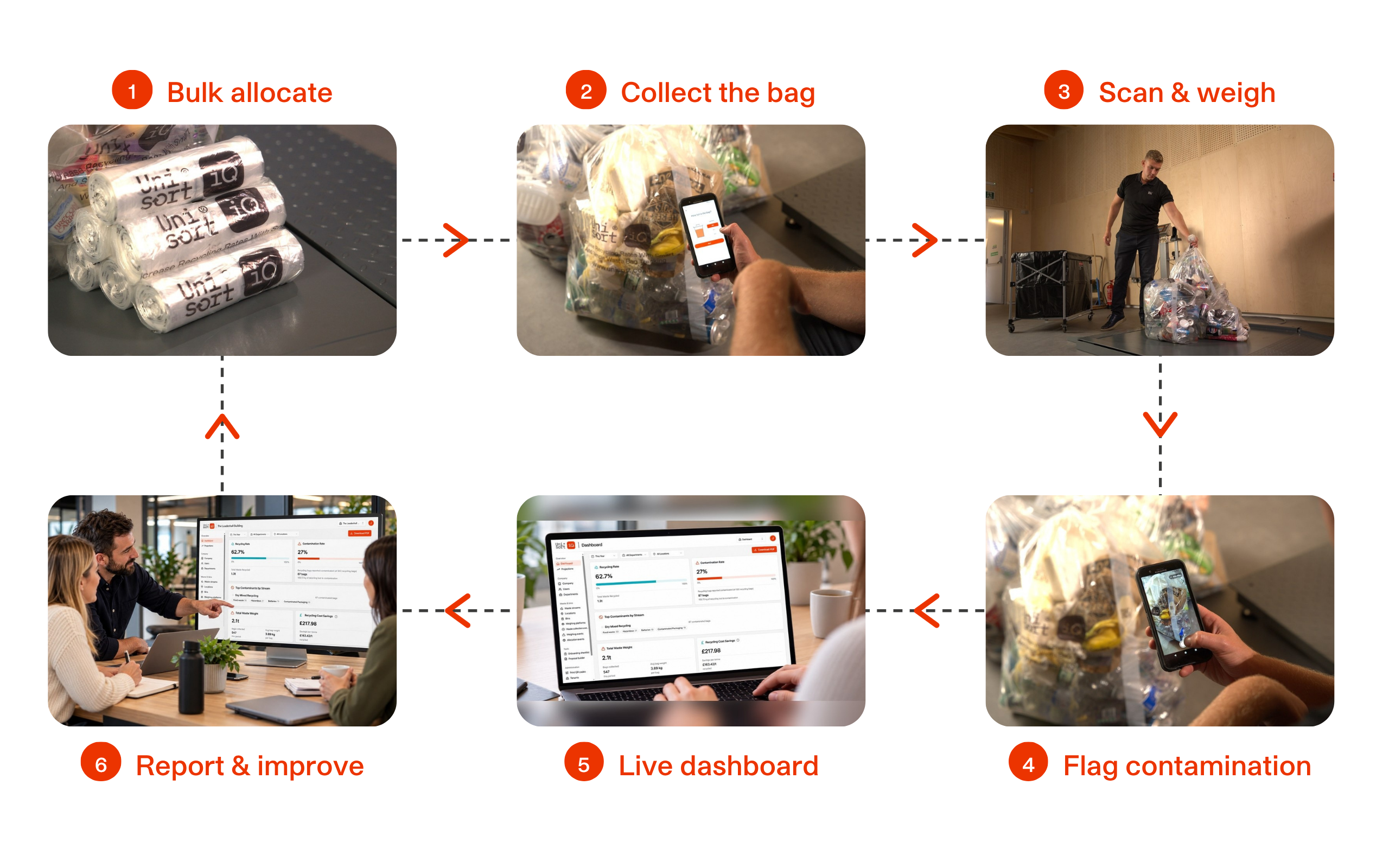
1. QR coded bags & Unisort Recycling Stations
Every bag carries a unique QR code linked to its recycling station, waste stream and location.
2. Scales
Each bag is weighed at collection for an accurate reading – not an estimate.
3. Unisort iQ App
Cleaners scan, weigh and report contamination in a few simple taps.
4. Online intelligence platform & data
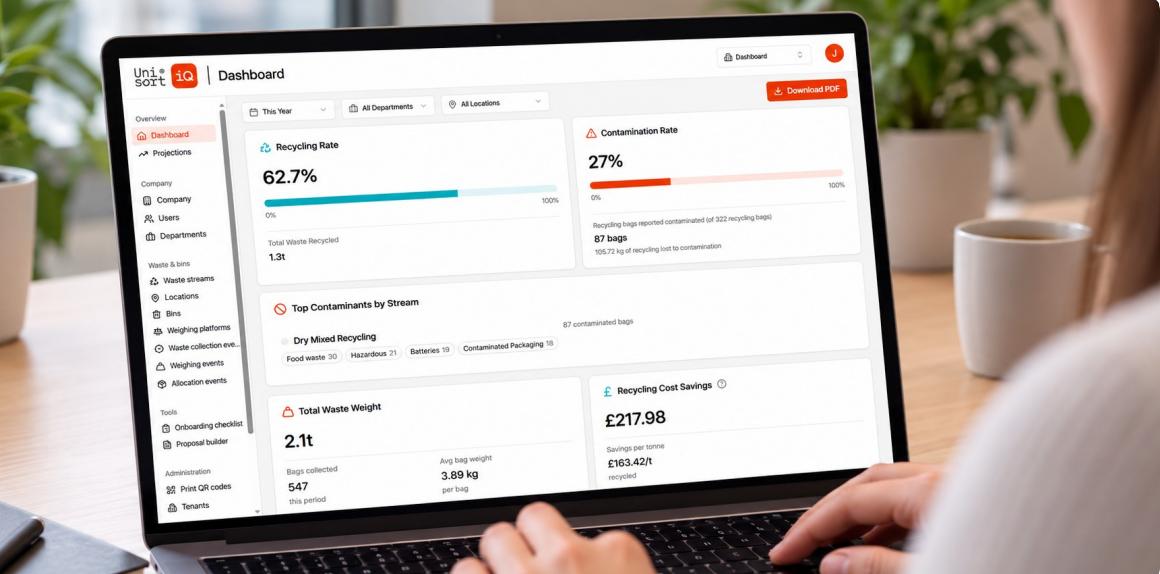
A real-time dashboard and audit-ready reports across every building, floor and waste stream.
Unisort iQ System
How it works
What Unisort iQ delivers
✓ Transparent waste data
See who produces what, across every tenant, department and site
✓ Fair cost recharging
Split costs by what each area actually produces
✓ Less contamination, more recycling
Trace problems to source and cut general waste costs
✓ Contractor accountability
Check collections and invoices against weighed data
✓ Proof that it’s working
Track the impact of training, signage and engagement
✓ Lower carbon, audit-ready reporting
Accurate data for compliance and ESG
Digital Waste Tracking
Mandatory from October 2026
What’s changing
✓ Paper waste notes phased out
✓ Digital reporting becomes mandatory
✓ Clear audit trails required
Why it matters
✓ Compliance must be proven
✓ Estimates won’t be enough
✓ Data accuracy becomes critical
How Unisort iQ helps
✓ Captures waste data digitally at source
✓ Tracks waste by site, floor & stream
✓ Tracks contamination back to the source, with evidence
✓ Produces audit-ready reports
Contact us
If you’d like to explore how Unisort iQ Workplace Waste Intelligence could improve recycling performance at your sites reach out to us.
"*" indicates required fields